
Introduction
Contacting a lawyer for the very first time can feel intimidating. Many people find themselves staring at a phone or blinking at a computer screen, unsure of what to say, what information matters, or how a legal consultation actually works. You might worry about sounding foolish, missing important details, or being unsure of what questions you should ask. These feelings are completely normal. When dealing with a legal issue—whether it is a property dispute, a family matter, an employment question, or a business contract—the entire environment can feel unfamiliar. However, a proper legal consultation is designed to bring clarity, not confusion. It gives the lawyer a chance to understand the core of your situation while giving you an opportunity to learn about your potential legal options. Preparation is the key to making this conversation productive and stress-free. By organizing your thoughts, gathering relevant papers, and understanding what to expect during a lawyer consultation, you can transform a nerve-wracking meeting into a calm, constructive conversation. This Lawyer Consultation Guide for First-Time Clients will walk you through every step of the process, from your initial preparation to follow-up steps and discovering the right legal professional.
What Is a Lawyer Consultation?
A legal consultation is an initial meeting between a potential client and a lawyer to discuss a specific legal issue. During this session, you share the main facts and background of your problem, while the lawyer listens, asks clarifying questions, and provides an initial assessment. It is important to understand the difference between an initial consultation and ongoing legal representation. An initial consultation is primarily exploratory and advisory. It allows both you and the lawyer to determine if there is a mutual fit and whether the lawyer handles your specific area of law. Ongoing legal representation, on the other hand, begins only after you formally engage the lawyer, sign an agreement or retainer, and outline a specific scope of work. The exact consultation process can vary significantly depending on the lawyer, your geographic location, the complexity of the legal matter, and the agreed-upon format. Knowing this helps set realistic expectations for your first-time legal consultation.
Why the First Lawyer Consultation Matters
The first conversation with a legal professional serves several vital functions. It helps you look at your situation objectively and understand the legal dimensions of your problem more clearly. Through this initial meeting, you can identify possible next steps, gather critical documents, become aware of strict deadlines or statutes of limitations, and evaluate potential risks. Most importantly, it helps you determine whether you actually need ongoing legal assistance or if the matter can be resolved through other means. It is crucial to note that one consultation cannot always resolve a legal matter entirely. Think of it as a diagnostic appointment rather than a complete cure. It gives you a roadmap so you can make informed decisions moving forward.
What to Do Before Your First Lawyer Consultation
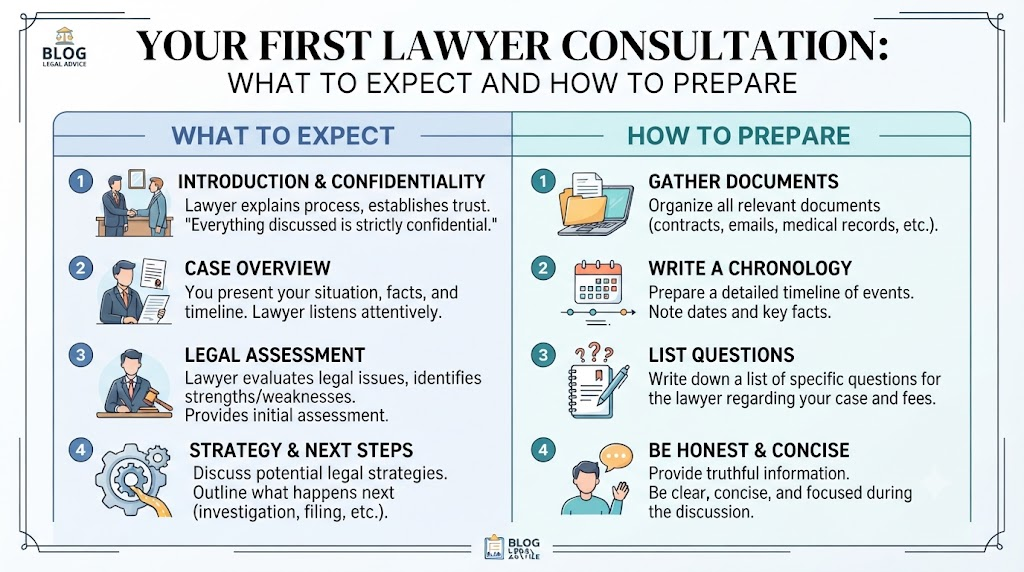
Preparation is your best tool for getting the most out of your legal consultation preparation. Walking into a meeting with a clear structure saves time and ensures you do not forget crucial details. Before your meeting, take time to write down the core issue in plain language. Summarize what happened, who is involved, and what your main goal is. Avoid getting bogged down in minor grievances or emotional venting; instead, focus on the core facts that a legal professional needs to know. Organizing your thoughts beforehand makes the entire lawyer consultation process much smoother for both you and your counsel.
Write a Simple Timeline of Events
Lawyers rely heavily on timelines to understand how events unfolded. Creating a basic chronology of your matter is one of the most practical steps you can take.
- List events in chronological order, starting from the beginning of the dispute or agreement.
- Include exact dates or approximate timeframes whenever possible.
- Note important milestones such as when a contract was signed, when a notice was received, or when a payment was made.
- Focus strictly on objective facts, communications, and actions rather than long emotional narratives.
A clean, written timeline allows the lawyer to grasp the sequence of events quickly, saving valuable consultation time for discussing solutions and strategy.
Documents to Prepare for a Lawyer Consultation
Having the right paperwork ready can dramatically improve the quality of your meeting. Depending on your specific situation, the documents you need may vary widely. There is no universal document checklist that fits every case, but common categories include:
- Contracts and Agreements: Signed documents, leases, employment contracts, or partnership agreements.
- Communications: Official letters, emails, text messages, or written notices exchanged with the other party.
- Financial Records: Receipts, invoices, bank statements, payment proofs, or tax documents related to the dispute.
- Property and Official Papers: Deed papers, corporate filings, government notices, or court papers if prior proceedings exist.
Gather these items into a single folder or digital file before your meeting so you can access them instantly if the lawyer asks a specific question.
How to Explain Your Legal Problem Clearly
When the meeting begins, start by explaining the main issue directly. Tell the lawyer what outcome you are hoping to achieve. Provide facts, dates, and background logically.
One of the biggest mistakes clients make is withholding uncomfortable facts or details that do not favor their position. Lawyers need accurate and complete information—including the weaknesses in your case—to provide realistic guidance. Hiding details only prevents your counsel from preparing an effective defense or strategy. Total honesty is essential during any legal advice for first-time clients.
What Happens During a Lawyer Consultation
Knowing what to expect inside the consultation room or video call can ease your anxiety. A typical consultation generally follows a structured path:
- Introduction and Overview: You explain your situation and goals while the lawyer listens carefully.
- Fact-Finding: The lawyer asks targeted questions to fill in gaps and reviews any documents you brought.
- Issue Identification: The lawyer identifies the legal principles, rights, and responsibilities involved in your case.
- Discussion of Options: The lawyer outlines potential strategies, risks, and possible outcomes.
- Next Steps and Fees: The lawyer explains what further work is required, estimated timelines, and how their fee structure operates.
Important Questions to Ask a Lawyer
Preparing a list of questions ensures you leave the meeting with clarity. Your questions should focus on understanding your options rather than pressuring the lawyer for unrealistic guarantees. Consider asking:
- What are my legal options, and which path do you recommend?
- What are the primary risks or potential challenges in my case?
- What is the expected timeline for resolving this matter?
- Are there any critical deadlines or filing dates I need to keep in mind?
- What documents or additional information do you need from me?
- How will we communicate, and who else on your team might handle my matter?
Questions About Legal Fees and Costs
Financial clarity is essential before entering into any professional relationship. Legal fees can vary widely based on the lawyer’s experience, location, complexity of the work, and the type of fee structure used (such as hourly rates, flat fees, or contingency arrangements).
Always ask what the quoted fee covers and what expenses are billed separately. Clarify whether the initial consultation has a fixed fee, whether ongoing work requires a retainer deposit, and how court costs, filing fees, or expert witness expenses are handled. Understanding these details upfront prevents unexpected surprises down the road.
How to Take Notes During the Consultation
During the meeting, information will move quickly, and legal terms may be introduced rapidly. Taking clear notes is vital.
- Write down key legal terms and their plain-English definitions.
- Note any specific documents or evidence the lawyer requested you to find.
- Record important deadlines, filing dates, or follow-up tasks assigned to you.
- Note the proposed next steps and the lawyer’s recommendations.
If you wish to record the audio of a consultation, never do so secretly. Always follow applicable local consent and privacy laws, and ask the lawyer for explicit permission beforehand.
How to Understand Legal Terms During the Consultation
Lawyers use professional terminology every day, but everyday clients do not. If your lawyer uses a term you do not understand, do not hesitate to interrupt politely and ask for a plain-English explanation.
Clear communication is the foundation of a good attorney-client relationship. If you do not understand the legal advice, risks, or options presented, you cannot make informed decisions about your own matter.
How to Ask Follow-Up Questions
After the lawyer explains the situation, you may need further clarification. Asking targeted follow-up questions ensures you are fully aligned before the meeting ends. Practical examples include:
- “Could you clarify what you mean by that specific term?”
- “What is the worst-case scenario if we choose this particular option?”
- “Are there alternative ways to resolve this dispute without going to court?”
- “What is the immediate next step I need to take today?”
Online Lawyer Consultation for First-Time Clients
With advancements in digital communication, online lawyer consultation has become a popular and convenient option for many clients. Video calls, phone conferences, and secure messaging platforms allow people to speak with legal professionals without traveling to an office.
To make the most of a remote session, ensure you are in a quiet, private space with a stable internet connection if using video. Have your digital files or physical documents organized and within arm’s reach, and keep your prepared list of questions on hand. Keep in mind that while remote consultations are ideal for initial discussions, certain legal matters may still require in-person meetings, original document verification, or physical court appearances.
How to Find a Lawyer for Your Legal Issue
Finding the right professional begins by identifying the broad category of law that applies to your situation. Legal practice is specialized, and you want someone whose experience matches your needs. Common categories include:
- Family Law: Divorce, child custody, alimony, and adoption.
- Property and Real Estate: Property disputes, lease agreements, title issues, and tenant matters.
- Employment Law: Workplace disputes, wrongful termination, discrimination, and employment contracts.
- Business and Corporate: Contract drafting, business formation, partnerships, and commercial disputes.
- Estate Planning: Wills, trusts, probate, and inheritance matters.
How BestLawyerNow.com Can Help First-Time Clients
Navigating the legal landscape for the first time can feel overwhelming when you do not know where to look for reliable guidance. Platforms like BestLawyerNow.com are designed to simplify this journey.
BestLawyerNow.com serves as an online lawyer discovery platform that helps users search for, compare, and connect with qualified legal professionals based on specific practice areas and locations. By streamlining the search process, the platform makes finding and initiating your first legal conversation much more convenient, saving you time and reducing the stress of searching independently.
How to Choose Between Different Lawyers
When evaluating multiple legal professionals, avoid choosing someone solely based on the cheapest price, flashy online ratings, or proximity. The right choice depends entirely on your specific legal needs. Consider factors such as:
- Relevant Experience: Does the lawyer regularly handle cases similar to yours?
- Jurisdiction: Are they licensed and familiar with local laws in your area?
- Communication Style: Do they explain things clearly and listen to your concerns?
- Availability: Can they dedicate sufficient time to your matter?
- Fee Transparency: Are their costs and billing methods clearly explained?
Common Mistakes First-Time Clients Should Avoid
Being aware of common pitfalls can help your initial meeting run much more smoothly. Try to avoid these typical mistakes:
- Arriving completely unprepared without a timeline or basic facts.
- Hiding unfavorable details out of embarrassment or fear.
- Bringing a disorganized pile of unrelated documents.
- Failing to ask questions or pretending to understand legal concepts you do not.
- Assuming the lawyer already knows the full background of your dispute.
- Expecting guaranteed outcomes or a 100% win rate.
- Ignoring deadlines or waiting until the last minute to seek help.
- Agreeing to ongoing legal work without understanding the scope and fee structure.
When a Legal Matter May Need Urgent Attention
Some legal matters involve strict, immovable deadlines or immediate legal consequences. Examples include responding to court summonses, official legal notices, urgent child custody disputes, impending property evictions, or approaching statutory filing deadlines.
When a strict deadline is involved, delays can severely harm your legal position. If your situation involves an urgent time constraint, contact an appropriately qualified lawyer promptly to protect your rights.
What to Do After the Consultation
Once your consultation concludes, the work does not end there. Take immediate steps to consolidate what you learned:
- Review and clean up your meeting notes while your memory is fresh.
- Gather any additional documents or evidence the lawyer requested.
- Write down any unanswered questions for a follow-up call.
- Review the proposed engagement agreement carefully before signing or committing to ongoing legal representation.
Frequently Asked Questions
What should I bring to my first legal consultation? Bring a written timeline of events, relevant contracts, letters, emails, receipts, and a prepared list of questions about your legal issue.
Will my consultation be completely confidential? In most jurisdictions, initial consultations are protected by attorney-client privilege, meaning the lawyer cannot generally disclose what you discuss, even if you do not ultimately hire them.
Can a lawyer guarantee that I will win my case? No ethical lawyer will guarantee a specific legal outcome, as courts, laws, and facts involve variables that cannot be predicted with 100% certainty.
Should I hire the first lawyer I consult? Not necessarily. You should choose a lawyer based on their experience, communication style, and comfort level, which is why consulting more than one professional is common.
What is the difference between a consultation and hiring a lawyer? A consultation is an initial exploratory meeting to evaluate your case and receive preliminary guidance. Hiring a lawyer involves signing a formal agreement for ongoing representation and legal work.
How are lawyer fees typically calculated? Fees can be structured as hourly rates, flat fees for specific services, or contingency fees depending on the nature of your legal matter.
Do I need an in-person meeting, or can it be done online? Many initial consultations can be conducted online via video or phone, though complex matters may eventually require in-person meetings.
What if I cannot afford a lawyer? You can look into legal aid organizations, pro bono legal services, or community legal clinics that assist individuals with limited financial means.
Should I record my conversation with the lawyer? You should never record a consultation secretly. Always ask for permission and ensure you comply with local privacy and consent laws.
How do I know what kind of lawyer I need? Identify the core nature of your problem—such as family, property, business, or employment—and search for professionals specializing in that specific practice area.
Conclusion
Taking your first steps into the legal world does not have to be stressful. By organizing your thoughts, assembling a clear timeline, gathering relevant documents, and preparing thoughtful questions, you can make your first lawyer consultation a productive and empowering experience. Remember that preparation brings clarity, helping you understand your options and next steps with confidence. When you are ready to discover and connect with qualified legal professionals who match your specific needs, explore resources and tools like BestLawyerNow.com to make your search smooth and straightforward.