
Introduction
Embarking on the journey to Canadian permanent residency is a life-changing decision. Whether you are an IT specialist seeking a tech hub, a healthcare professional looking for stability, or a student planning your future, the pathway is governed by the Canada PR points calculator—the key to the Express Entry system.
Canada’s immigration system is built on merit. It selects individuals who can integrate quickly into the economy and contribute to the nation’s growth. However, many aspirants struggle to understand the distinction between qualifying for the pool and actually receiving an Invitation to Apply (ITA). This guide is designed to strip away the complexity, providing you with a clear, authoritative look at how you can optimize your profile for the 2026 immigration cycle.
What Is the Canada PR Points Calculator?
The Canada PR points calculator is a tool used to estimate your Comprehensive Ranking System (CRS) score.
Why Canada Uses the CRS System
The CRS is a points-based system that ranks your profile against others in the Express Entry pool. Think of it as a competition where the highest-scoring individuals are invited first. Canada uses this to ensure that the immigration process remains objective, transparent, and aligned with current labor market needs.
Eligibility Score vs. CRS Invitation Score
It is essential to distinguish between the two:
- The 67-Point Eligibility Check: This is the “pass mark” to get into the Federal Skilled Worker Program (FSWP) pool. It is not the same as your ranking score.
- The CRS Score (1,200 points): Once you are in the pool, this score determines your actual rank.
Beginner-Friendly Tip: If you have higher IELTS scores and significant Canadian work experience, your CRS score will naturally rise, putting you in a better position for the next draw.
How the Canada PR Points System Works
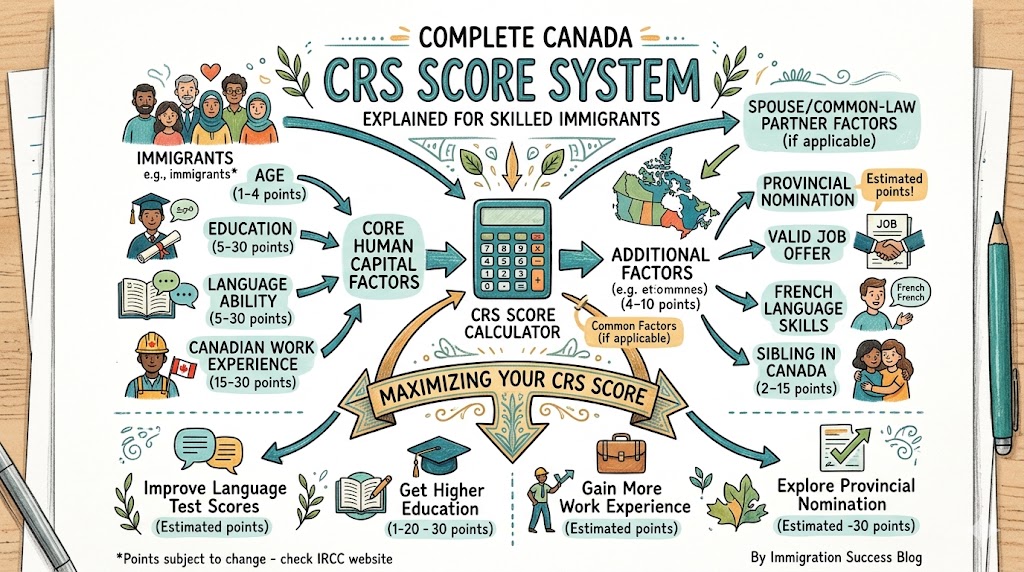
Your CRS score is derived from several “Human Capital” factors. The system rewards you for the attributes that suggest a high probability of success in the Canadian labor market.
Core Scoring Factors
| Factor | Maximum Points (Single Applicant) | Why It Matters |
| Age | 110 | Canada prioritizes younger workers (20–29). |
| Education | 150 | Higher degrees signify specialized knowledge. |
| Language | 170 | Fluency ensures workplace integration. |
| Work Experience | 80 | Demonstrates practical professional capability. |
Canada Express Entry System Explained
Express Entry is the primary gateway for skilled immigrants. It manages applications for:
- Federal Skilled Worker Program (FSWP): Designed for professionals with international experience.
- Canadian Experience Class (CEC): For those who have already gained skilled work experience within Canada.
- Federal Skilled Trades Program (FSTP): For those qualified in specific industrial or technical trades.
- Provincial Nominee Program (PNP): Streams where specific provinces nominate you, providing a massive points boost.
CRS Score Breakdown: The Path to 1,200
To reach a competitive score, you must understand where your points originate:
- Core Human Capital: Age, education, language, and Canadian work experience (up to 500 points).
- Skill Transferability: How your education and experience complement your language abilities (up to 100 points).
- Additional Factors: Provincial nominations, siblings in Canada, or a valid job offer (up to 600 points).
Points Optimization Strategy
| Strategy | Potential Point Gain | Effort Required |
| Provincial Nomination | +600 | High (Program-specific) |
| Higher Language Test (CLB 9+) | +50 | Medium (Test prep) |
| French Language (NCLC 7+) | +50 | High (Consistent study) |
| Additional Year of Experience | +20 to +50 | Low (Time-based) |
Step-by-Step Calculation: A Practical Example
Consider Rahul, a 29-year-old software engineer:
- Age (29): 110 points.
- Education (Master’s): 135 points.
- Language (IELTS CLB 9): 124 points.
- Work Experience (3 years): 70 points.
- Skill Transferability: 50 points.
Total Estimated CRS: 489 points. With this score, Rahul is well-positioned for most federal draws.
How to Improve Your CRS Score
If you are currently below the required cut-off, focus on these “levers”:
- The Language Boost: Moving from CLB 8 to CLB 9 is the single most common way to add 50+ points to a profile.
- The French Advantage: With recent government shifts, French proficiency is highly rewarded.
- Provincial Nominee Programs (PNPs): Securing a nomination from a province like Ontario or Alberta is essentially a “golden ticket” that guarantees an ITA.
Real-Life Case Studies
- Case 1: The IT Professional
- Challenge: Initial score of 430.
- Strategy: Retook IELTS to hit CLB 9 and targeted an Ontario Tech-specific draw.
- Result: Score rose to 480; invited within four months.
- Case 2: The Married Couple
- Challenge: Both had low individual scores.
- Strategy: Assessed the spouse’s education (ECA) and language scores to contribute to the primary applicant’s profile.
- Result: Added 25 points, pushing them over the threshold.
- Case 3: The Healthcare Worker
- Challenge: Score of 400.
- Strategy: Applied through a rural-focused PNP stream.
- Result: Nominated by the province (+600 points) and secured PR in record time.
Frequently Asked Questions (FAQs)
- What is a good CRS score? Typically, 480+ is competitive.
- Is age the most important factor? It is significant, but language and education often carry more weight in the total.
- Can I apply without a job offer? Yes, the FSWP does not require a job offer.
- How long is the Express Entry profile valid? 12 months.
- What happens after I get an ITA? You have 60 days to submit your complete e-APR (Application for Permanent Residence).
- Does my spouse need to do the IELTS? It is highly recommended if they want to contribute points.
- Is there a minimum age to apply? You must be at least 18.
- Can I use an expired IELTS score? No, it must be less than two years old.
- Are there points for volunteer work? No, only paid skilled work counts.
- What if my NOC code changes? Always ensure you use the latest version of the TEER system.
- How long does the process take? Most Express Entry applications are processed within 6 months.
- Are there any other ways to immigrate? Yes, through study permits or temporary work permits that lead to permanent status.
Conclusion: Take Action Today
The Canadian dream is within your reach, but it requires a strategic approach. The CRS score is more than just a number; it is a reflection of your preparation. By proactively managing your language scores, validating your educational credentials, and exploring the vast network of Provincial Nominee Programs, you transform your profile from “average” to “competitive.”
Do not view the points-based system as a barrier, but rather as a checklist for your own growth. The effort you invest in improving your profile today will pay off in the form of a successful immigration journey tomorrow. Stay informed, stay consistent, and keep your focus on the goal. Your future in Canada is waiting.