
INTRODUCTION
Dreaming of a career in the heart of Europe? Austria offers a high quality of life, a stable economy, and incredible professional growth opportunities. But for many, the path to living there begins with one crucial step: understanding the immigration system.
The Austria PR Points Calculator is your first tool in this journey. It’s not just a set of numbers; it’s a roadmap. By understanding how the Red-White-Red (RWR) Card works, you can assess your chances of success before you even submit an application.
In this guide, we’ll break down exactly how the points system functions, how you can boost your score, and the step-by-step process to transition from a skilled worker to a long-term resident. Let’s turn that dream of working in Austria into a concrete plan.
What Is the Austria PR Points Calculator?
Think of the Austria PR Points Calculator as a “pre-flight check” for your immigration journey.
It is an objective tool used to evaluate your qualifications against the requirements set by the Austrian Public Employment Service (AMS). Austria uses this points-based system to ensure that incoming talent matches the needs of their labor market.
How It Works
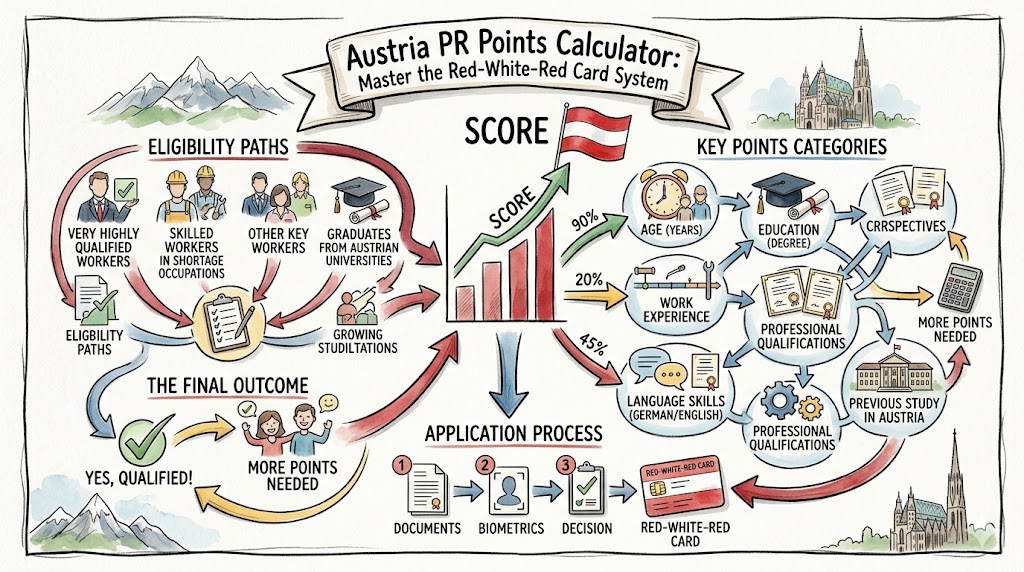
You are awarded points based on specific criteria like your age, education, work experience, and language skills. Each category has a minimum threshold (the “pass mark”) you must reach to be eligible for the RWR Card.
- Eligibility vs. Approval: It is vital to note that passing the points check proves you meet the criteria, but your official approval is granted by the authorities (AMS) after reviewing your documentation.
- Simple Example: If you are a 28-year-old software engineer with a Master’s degree and five years of experience, your profile will naturally accumulate more points than someone who is 45 and just starting their career.
Austria PR Points System Explained
The points system is designed to favor candidates who bring value to the Austrian economy. Here is how the scoring generally breaks down:
1. Education Points
Higher qualifications yield higher points. Whether you hold a Bachelor’s, Master’s, or a specialized vocational degree, your academic background is a primary driver of your score.
2. Work Experience
Experience is measured in years. In many categories, you get points for every half-year of relevant work. If you have already worked in Austria, those points are often weighted more heavily.
3. Age Factor
Austria incentivizes younger professionals. Generally, applicants under 35 or 40 receive the maximum points in this category, while those over 45 may receive fewer or no points.
4. Language Skills
German is the official language, and proficiency (at the A1, A2, or B1 level) can significantly boost your score. English proficiency is also rewarded, especially if it is the primary language of your potential workplace.
5. Bonus Points
You can often earn “extra” points for factors like completing studies in Austria, having a job offer in a shortage occupation, or specialized skills like research expertise.
The Red-White-Red Card System: An Overview
The Red-White-Red Card is the gateway to working and living in Austria. It is categorized to fit different types of talent:
| Category | Best For | Requirement |
| Very Highly Qualified | Top-tier experts & researchers | High points, no initial job offer required |
| Shortage Occupations | Professionals in high-demand fields | Job offer required |
| Other Key Workers | Specialized professionals | Job offer required |
| Start-up Founders | Entrepreneurs | Business plan & capital |
How Austria PR Points Are Calculated
Calculation is a game of gathering evidence. Each point you claim must be backed by official documentation.
Sample Profile Calculation
Imagine a 32-year-old IT specialist (Shortage Occupation category):
- Education: Bachelor’s in CS (30 points)
- Experience: 4 years (8 points)
- Language: German A2 (10 points) + English B1 (10 points)
- Age: Under 30/40 (10 points)
- Total: 68 Points.
- Result: Above the threshold of 55, making them a strong candidate.
Step-by-Step Application Process
- Check Eligibility: Use the official calculators to ensure you meet the minimum points for your chosen category.
- Collect Documents: Gather degrees, work experience letters, language certificates, and your passport.
- Secure a Job Offer: For most categories, you need a contract from an Austrian employer who meets salary thresholds.
- Submit Application: Apply through the Austrian embassy or consulate in your home country.
- AMS Evaluation: The AMS verifies that you meet the labor market requirements and your points score.
- Approval: Upon approval, you receive your visa to enter Austria and pick up your RWR card.
Essential Documents Required
- Valid Passport: Your primary proof of identity.
- Degree Certificates: Legalized and translated academic transcripts.
- Work Experience Letters: Detailed proof of your roles and responsibilities.
- Language Certificates: Officially recognized tests (e.g., ÖSD, Goethe-Institut).
- Employment Contract: Signed job offer with specific salary details.
- Accommodation Proof: Evidence of where you will live initially.
How to Increase Your Austria PR Points
- Learn German: This is the most effective way to jump your score. Moving from no German to A2 or B1 provides a massive boost.
- Upskill: Gain an additional certification in your field.
- Target Shortage Occupations: Research the annual list of shortage occupations in Austria; if your skills align, you may find an easier route.
- Gain Experience: Every six months of experience adds to your tally. If possible, seek project work that aligns with international standards.
Common Mistakes Applicants Make
- Choosing the Wrong Category: Many apply as a “Key Worker” when their profile better fits “Very Highly Qualified.”
- Ignoring Language Requirements: Relying only on English when the system heavily favors German.
- Missing Documents: Incomplete or uncertified translations of diplomas.
- Applying Without a Job Offer: Assuming you can just go to Austria to look for work without first securing an RWR-compliant offer (unless you qualify for the Job Seeker Visa for high-qualified workers).
Real-Life Examples
Example 1: The IT Professional
- Profile: 30 years old, 3 years experience, Master’s degree.
- Points: High score due to young age and high education.
- Outcome: Highly likely to qualify for an RWR card under Shortage Occupations.
Example 2: The Experienced Skilled Worker
- Profile: 42 years old, 15 years experience, Vocational training.
- Points: Very high experience points, but lower age points.
- Outcome: Still strong, provided they have a job offer in a high-demand sector.
Frequently Asked Questions (FAQs)
- What is the Austria PR Points Calculator? An orientation tool to estimate your eligibility for residence permits.
- Is German required for PR? Yes, it is highly beneficial for both points and long-term integration.
- How many points are needed? It varies by category, usually between 50 and 70.
- Can I apply without a job offer? Only in specific categories, like “Very Highly Qualified.”
- How long does the RWR Card take? Usually 2–4 months, but this varies by embassy.
- Can I convert RWR to PR? Yes, the RWR Card Plus is the intermediate step to permanent residency.
- Is the calculator official? It is an orientation tool; the AMS makes the final decision.
- Does experience outside Austria count? Yes, it is fully counted in your points.
- What if I don’t meet the points? You may need to gain more experience or improve language skills before reapplying.
- Do I need a lawyer? Not mandatory, but helpful for complex cases.
Conclusion
The path to Austria is paved with preparation. By using the Austria PR Points Calculator, you are already taking a proactive step toward your future. Remember, the points are a reflection of your potential value to the Austrian labor market—focus on language, education, and gaining relevant experience to maximize your chances.
Stay focused, gather your documents early, and view the process as a career-building exercise. Austria is waiting for talent like yours.