
Introduction
The Certified FinOps Engineer credential has emerged as one of the most vital qualifications for modern technology professionals working in cloud environments. As organizations scale their digital infrastructure across multi-cloud and hybrid ecosystems, managing cloud expenditures has transitioned from a quarterly accounting chore into an essential engineering discipline. This guide provides a comprehensive overview of the Certified FinOps Engineer path for software engineers, platform architects, Site Reliability Engineers (SREs), and technical managers seeking to bridge the gap between technical operations and financial accountability.
Within the contemporary software ecosystem, cloud efficiency directly impacts an organization’s bottom line and unit economics. Engineering teams can no longer build and deploy applications without considering variable cost structures, resource allocation, and operational waste. By mastering financial operations alongside technical delivery, engineers position themselves as strategic assets capable of driving maximum business value. This guide outlines the structure, skills, career impact, and strategic preparation needed to succeed in earning and applying the Certified FinOps Engineer credential.
What is the Certified FinOps Engineer?
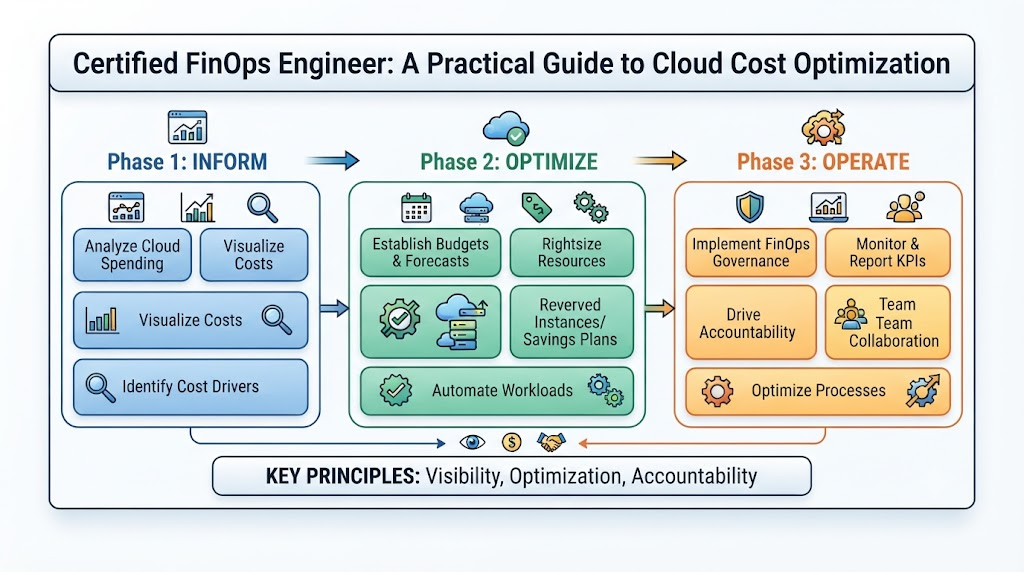
The Certified FinOps Engineer represents a shift from reactive cost-cutting to proactive, continuous cloud financial health. Unlike generic certifications that focus strictly on vendor-specific cloud administration tools, this certification emphasizes a production-focused approach centered around the core FinOps lifecycle: Inform, Optimize, and Operate. It provides engineers with a standardized framework to communicate effectively with finance, procurement, and executive leadership without compromising development velocity or architectural resilience.
The program exists to formalize the discipline of cloud financial management within software engineering and operational workflows. It aligns financial accountability with daily sprint activities, infrastructure deployment, and architectural design decisions. Through practical frameworks, engineers learn how to measure costs in real time, automate optimization policies, and treat cloud expenses as a primary operational metric alongside performance, security, and uptime.
Who Should Pursue Certified FinOps Engineer?
The Certified FinOps Engineer program is specifically designed for technical professionals and engineering leaders who design, deploy, and manage cloud infrastructure. Cloud engineers, SREs, DevOps specialists, platform engineers, and systems architects benefit immensely from integrating cost governance into their technical toolkits. Additionally, software developers working on microservices architectures find this credential invaluable for writing cost-efficient code and selecting scalable runtime parameters.
This credential is also highly relevant for technical managers, engineering directors, and product owners who hold budgetary responsibilities for cloud projects. From a geographic perspective, the certification holds significant value across both global enterprise markets and technology hubs in India, where large-scale cloud transformations and global delivery centers require rigorous cost optimization. Beginners looking to enter cloud operations gain a competitive advantage, while senior engineers elevate their impact by influencing core business strategy.
Why Certified FinOps Engineer
Enterprise cloud adoption continues to accelerate, but unmanaged cloud spend remains one of the largest operational risks for growing businesses. Organizations frequently experience “cloud bill shock” due to idle resources, misconfigured auto-scaling, and unoptimized architectural patterns. The Certified FinOps Engineer program equips professionals with the methodologies needed to identify, remediate, and prevent unnecessary expenditure, making these engineers indispensable across enterprise environments.
The long-term value of this credential lies in its vendor-neutral, foundational focus on financial principles rather than short-lived tool interfaces. While specific cloud console menus and third-party tools change constantly, the core tenets of cost allocation, unit economics, rightsizing, and automated governance remain permanent. Investing time into this certification yields high career returns, establishing professionals as technical leaders who protect company margins while enabling rapid technological innovation.
Certified FinOps Engineer Certification Overview
The Certified FinOps Engineer program is delivered via official structured curricula and hosted on FinOpsSchool. It utilizes an applied assessment methodology that tests real-world problem-solving, architectural efficiency analysis, and data-driven billing interpretation alongside core conceptual knowledge. The program is designed and maintained by active industry practitioners to ensure content directly mirrors current multi-cloud and enterprise delivery challenges.
The certification structure spans distinct expertise tiers ranging from foundational principles to advanced governance architectures. Candidates are evaluated on their ability to ingest billing datasets, configure granular tagging policies, calculate unit cost metrics, and implement programmatic remediation pipelines. By grounding the curriculum in practical engineering workflows, the program ensures certified candidates can deliver immediate operational value to their organizations.
Certified FinOps Engineer Certification Tracks & Levels
The Certified FinOps Engineer framework is structured into progressive certification levels to support engineers at every stage of their career journey. The Foundation level introduces core terminology, cost allocation mechanics, and basic visibility frameworks. The Professional level dives deep into automated rightsizing, architectural optimization, commitment-based discount management, and CI/CD cost guardrails.
Advanced and Expert tracks focus on enterprise-wide FinOps strategy, custom unit economics models, multi-cloud governance frameworks, and organizational culture transformation. Specialization tracks cater to specific technology domains, including FinOps for Kubernetes, FinOps for Data Platforms, and FinOps for AI/ML Workloads. This tiered structure ensures clear progression from individual contributor to strategic technical director.
Complete Certified FinOps Engineer Certification Table
| Track | Level | Who it’s for | Prerequisites | Skills Covered | Recommended Order |
| FinOps Engineering | Foundation | Junior Engineers, Analysts, IT Managers | Basic Cloud Knowledge | FinOps Lifecycle, Terminology, Tagging, Visibility | Step 1 |
| FinOps Engineering | Professional | DevOps, SREs, Cloud Engineers | 1+ Year Cloud Ops | Rightsizing, Anomaly Detection, Automation, Unit Economics | Step 2 |
| FinOps Engineering | Advanced / Expert | Architects, Directors, Principal Engineers | Professional Cert | Enterprise Governance, Multi-Cloud Strategy, Cultural Change | Step 3 |
| Container FinOps | Specialization | Kubernetes Engineers, Platform Teams | Foundation Level | K8s Resource Requests, Pod Cost Allocation, Autoscaling | Step 4 (Optional) |
| Data & AI FinOps | Specialization | Data Engineers, MLOps Professionals | Foundation Level | Big Data Cost Allocation, Model Training Spend, Query Tuning | Step 5 (Optional) |
Detailed Guide for Each Certified FinOps Engineer Certification
Certified FinOps Engineer – Foundation Level
What it is
The Foundation certification validates a candidate’s grasp of cloud cost visibility, fundamental FinOps terminology, and basic resource allocation strategies. It confirms that an engineer understands how cloud variable spend models function and can participate effectively in cost-aware engineering workflows.
Who should take it
This exam is suitable for junior cloud engineers, systems administrators, IT financial analysts, and software developers who want to build a solid baseline in cloud financial management principles.
Skills you’ll gain
- Understanding cloud billing structures and variable spend dynamics
- Applying standardized resource tagging and cost allocation strategies
- Navigating the Inform, Optimize, and Operate phases of the FinOps lifecycle
- Identifying unallocated spend and mapping costs to business units
Real-world projects you should be able to do
- Design and implement a organization-wide cloud tagging policy
- Create visibility dashboards mapping cloud infrastructure spend to specific engineering teams
- Audit monthly cloud invoices to identify baseline spending trends and anomalies
Preparation plan
- 7–14 days: Review the official FinOps framework documentation and memorize core terminology and persona roles.
- 30 days: Analyze sample billing CSV/JSON exports and practice grouping costs by tags, regions, and services.
- 60 days: Build a functional cloud cost reporting dashboard using standard cloud-native reporting tools.
Common mistakes
- Treating FinOps as purely a finance function rather than an engineering discipline
- Memorizing definitions without understanding how cost data flows through cloud provider APIs
- Neglecting the cultural and collaborative aspects of stakeholder alignment
Best next certification after this
- Same-track option: Certified FinOps Engineer – Professional Level
- Cross-track option: Certified DevOps Engineer
- Leadership option: Certified Cloud Delivery Manager
Certified FinOps Engineer – Professional Level
What it is
The Professional certification validates an engineer’s ability to automate cost optimization, execute complex rightsizing, and integrate financial guardrails directly into modern DevOps delivery pipelines. It proves hands-on mastery over cloud resource efficiency.
Who should take it
Designed for experienced DevOps engineers, SREs, Cloud Architects, and Systems Engineers who actively manage live production infrastructure and deployment systems.
Skills you’ll gain
- Automated resource cleanup, scheduling, and lifecycle management
- Programmatic management of Reserved Instances, Savings Plans, and Spot instances
- Calculating unit economics and establishing cost-per-transaction telemetry
- Building CI/CD pipeline cost estimation checks and pull-request guardrails
Real-world projects you should be able to do
- Develop automated serverless routines to shut down non-production environments outside business hours
- Configure container request/limit auto-tuning based on historical utilization telemetry
- Implement real-time anomaly detection alerts triggered by sudden cloud spend spikes
Preparation plan
- 7–14 days: Study cloud cost management APIs, SDKs, and CLI tooling for major cloud platforms.
- 30 days: Write and test scripts for automated resource cleanup, volume snapshot management, and rightsizing.
- 60 days: Conduct a comprehensive cost audit of a production-grade infrastructure environment and execute remediation.
Common mistakes
- Aggressively downsizing resources without evaluating application performance metrics and SLAs
- Relying exclusively on manual console interventions rather than code-driven automation
- Overlooking data transfer and egress costs when optimizing compute and storage assets
Best next certification after this
- Same-track option: Certified FinOps Engineer – Advanced / Expert Level
- Cross-track option: Certified Site Reliability Engineer (SRE)
- Leadership option: Engineering Manager Certification
Certified FinOps Engineer – Advanced / Expert Level
What it is
The Advanced certification validates strategic expertise in designing multi-cloud governance structures, driving enterprise-wide FinOps culture shift, and establishing high-level organizational financial policies.
Who should take it
Intended for Lead Architects, Principal SREs, Head of Infrastructure, and Technical Directors responsible for multi-million-dollar cloud budgets across complex enterprise environments.
Skills you’ll gain
- Enterprise multi-cloud cost allocation and chargeback/showback governance
- Executive financial reporting, forecasting, and commitment risk management
- Architecting cloud systems for optimal structural cost efficiency from inception
- Leading cultural transformation and embedding cost accountability into organizational KPIs
Real-world projects you should be able to do
- Establish an enterprise FinOps Center of Excellence (FCoE) charter and operational workflow
- Implement a multi-cloud cost unification platform using open billing standards
- Design custom unit economic models linking cloud infrastructure costs directly to customer growth revenue
Preparation plan
- 7–14 days: Analyze enterprise financial structures, procurement workflows, and executive reporting requirements.
- 30 days: Draft comprehensive multi-cloud governance policies and chargeback frameworks.
- 60 days: Lead a mock enterprise digital transformation case study focusing on organizational FinOps adoption.
Common mistakes
- Focusing solely on technical fixes while neglecting executive buy-in and organizational change management
- Designing overly rigid compliance frameworks that slow down product engineering velocity
- Failing to adjust unit economic metrics as the underlying business model scales
Best next certification after this
- Same-track option: Specialized FinOps Domain Certifications (Containers / AI)
- Cross-track option: Enterprise Cloud Solutions Architect
- Leadership option: Director of Infrastructure / VP of Engineering Track
Choose Your Learning Path
DevOps Path
The DevOps learning path integrates financial feedback directly into software delivery lifecycles. Engineers learn to introduce infrastructure cost testing alongside functional testing inside CI/CD pipelines. By viewing cost as a critical build-quality metric, DevOps engineers prevent expensive code deployments before they reach production environments. This path builds expertise in automated provisioning, infrastructure-as-code optimization, and continuous deployment guardrails.
DevSecOps Path
The DevSecOps learning path combines security, compliance, and cost governance into a unified operational control plane. Unused, orphaned, or misconfigured cloud resources frequently present both security vulnerabilities and financial waste. Engineers following this path master techniques to identify abandoned assets, enforce automated compliance policies, and ensure that security tool telemetry does not generate runaway logging expenses.
SRE Path
The Site Reliability Engineering path focuses on balancing system reliability, availability, and performance against total infrastructure expense. SREs utilize FinOps principles to evaluate the true financial cost of system availability, error budgets, and redundant capacity. This path emphasizes defining service level objectives (SLOs) that align customer satisfaction requirements with cost-effective architecture design.
AIOps Path
The AIOps path leverages machine learning and automated analytics to manage cloud operations and financial optimization at scale. Engineers learn to deploy intelligent anomaly detection models that catch billing spikes faster than static thresholds allow. This path focuses on utilizing operational telemetry to predict future resource needs, automate rightsizing decisions, and streamline complex billing analysis across massive distributed architectures.
MLOps Path
The MLOps path addresses the unique financial challenges associated with training, tuning, and deploying artificial intelligence and machine learning models. Graphics processing units (GPUs) and specialized hardware accelerators represent significant cloud expenditures. Engineers on this path learn to optimize model training jobs, manage persistent storage for massive datasets, rightsized inference endpoints, and track the exact cost per model prediction.
DataOps Path
The DataOps path concentrates on governing expenses across large-scale data pipelines, data warehouses, and analytics platforms. Consumption-based billing in modern data platforms can quickly escalate if queries and ETL pipelines are unoptimized. This path teaches engineers how to optimize query performance, manage data retention lifecycles, attribute shared compute costs across departments, and enforce query execution guardrails.
FinOps Path
The dedicated FinOps path is designed for professionals specializing entirely in cloud financial management as a core practice. This track provides end-to-end expertise spanning finance, procurement, and platform engineering. Practitioners learn how to bridge executive strategy with technical execution, manage cloud vendor negotiations, construct corporate chargeback mechanisms, and cultivate an organizational culture of financial responsibility.
Role → Recommended Certified FinOps Engineer Certifications
| Role | Recommended Certifications |
| DevOps Engineer | Certified FinOps Engineer – Professional, FinOps for Containers |
| SRE | Certified FinOps Engineer – Professional, SRE Certification |
| Platform Engineer | Certified FinOps Engineer – Professional, FinOps for Kubernetes |
| Cloud Engineer | Certified FinOps Engineer – Foundation & Professional |
| Security Engineer | Certified FinOps Engineer – Foundation, DevSecOps Certification |
| Data Engineer | Certified FinOps Engineer – Professional, FinOps for Data Platforms |
| FinOps Practitioner | Certified FinOps Engineer – Foundation, Professional & Advanced |
| Engineering Manager | Certified FinOps Engineer – Foundation & Advanced Governance |
Next Certifications to Take After Certified FinOps Engineer
Same Track Progression
After mastering the core Certified FinOps Engineer certification, professionals should pursue specialized domain tracks to deepen their technical authority. Gaining specialized credentials in areas such as FinOps for Containers, FinOps for Big Data Platforms, or FinOps for AI/ML Workloads allows engineers to solve complex cost challenges in specialized environments. Advanced practitioners should target the Expert/Strategic Governance level to master enterprise chargeback architectures.
Cross-Track Expansion
To build a versatile engineering profile, combining FinOps expertise with complementary operational disciplines is highly effective. Pursuing credentials in DevOps engineering, Site Reliability Engineering, or Cloud Security Architecture enables engineers to evaluate systems holistically. Understanding how security controls, delivery automation, and reliability targets intersect with cloud economics makes an engineer significantly more impactful.
Leadership & Management Track
For engineers aspiring to transition into leadership positions, combining FinOps mastery with engineering management qualifications is a logical step. Executive leadership increasingly values engineering managers who possess direct command over unit economics and cloud budgeting. Moving toward certifications in Technical Program Management, Agile Leadership, or IT Service Governance equips professionals to lead high-performing, cost-efficient technology departments.
Training & Certification Support Providers for Certified FinOps Engineer
The Core Platform Authority
FinOpsSchool serves as a premier platform dedicated exclusively to cloud financial management education and technical governance certification. The platform provides structured learning paths designed by active industry leaders to bridge the divide between software engineering practices and corporate finance requirements. Through a combination of rigorous theoretical frameworks and hands-on production scenario labs, it enables candidates to master cloud spend visibility, automated resource optimization, and enterprise governance models. FinOpsSchool content is continuously updated to reflect evolving multi-cloud billing structures, containerized spend mechanics, and AI workload cost dynamics, ensuring that professionals receive practical, market-aligned instruction.
DevOpsSchool
DevOpsSchool is a globally recognized professional education platform specializing in end-to-end DevOps, Cloud, SRE, and FinOps training programs. It offers comprehensive candidate support including live instructor-led training, practical laboratory environments, real-world case studies, and extensive exam preparation materials. The platform emphasizes hands-on mastery over tooling, infrastructure automation, and enterprise implementation patterns, helping thousands of engineers advance their careers. With a faculty of seasoned industry practitioners, it provides personalized mentorship and interactive learning experiences tailored to working professionals and enterprise teams globally.
Cotocus
Cotocus provides specialized IT consulting and technical workforce enablement services designed for modern digital enterprises. Its training programs focus on practical engineering workflows, cloud infrastructure optimization, continuous delivery pipelines, and operational cost governance across hybrid cloud environments.
Scmgalaxy
Scmgalaxy is a popular community-driven educational platform focused on software configuration management, DevOps tooling, build engineering, and cloud operations. It offers extensive tutorial resources, documentation, community forums, and training modules tailored for software engineers.
BestDevOps
BestDevOps offers targeted career development resources, technical bootcamps, and certification prep paths for engineers seeking to upgrade their cloud skills. The platform specializes in practical learning modules covering automation, cloud architecture, and cost efficiency.
devsecopsschool.com
devsecopsschool.com focuses exclusively on integrating security practices into rapid software delivery and cloud infrastructure management. Its curriculum covers secure coding, compliance automation, cloud security posture, and the financial impact of security operations.
sreschool.com
sreschool.com provides advanced learning programs dedicated to Site Reliability Engineering principles, observability frameworks, and system resilience. The platform helps engineers balance performance targets, error budgets, and infrastructure efficiency.
aiopsschool.com
aiopsschool.com specializes in artificial intelligence for IT operations, teaching engineers how to apply machine learning algorithms to telemetry data, automated event correlation, intelligent alerting, and predictive cloud cost optimization.
dataopsschool.com
dataopsschool.com delivers structured training paths for data platform engineers, analytics architects, and database administrators, focusing on efficient data pipeline management, data governance, and analytics infrastructure spend optimization.
finopsschool.com
finopsschool.com is the dedicated learning portal for cloud financial management education, offering targeted courses on cloud billing analytics, unit economics modeling, container cost allocation, and multi-cloud governance strategy.
Frequently Asked Questions (General)
- What is the main objective of the Certified FinOps Engineer program?
The primary objective is to equip engineers with the knowledge and tools needed to optimize cloud expenditures, establish spend visibility, and align technical decisions with financial value.
- How long does it take to prepare for the Certified FinOps Engineer exam?
Most candidates with prior cloud experience require between 3 to 6 weeks of dedicated study, spending approximately 5 to 10 hours per week reviewing materials and completing practical labs.
- Are there formal prerequisites required before taking the exam?
While there are no mandatory strict prerequisites for the Foundation level, having a basic understanding of cloud computing services and core IT concepts is highly recommended.
- Is the Certified FinOps Engineer credential recognized internationally?
Yes, the certification is globally recognized across tech hubs worldwide, validating skills that apply to both multi-national enterprise environments and fast-growing technology startups.
- How does this certification differ from cloud provider specific certs?
Cloud provider certifications focus primarily on native administration tools for a single platform, whereas this program teaches vendor-neutral financial principles, lifecycle frameworks, and multi-cloud strategies.
- Can software developers benefit from obtaining this certification?
Absolutely. Developers learn to write cost-conscious code, configure optimal resource parameters, and understand the direct financial impact of their application design choices.
- How long is the Certified FinOps Engineer certification valid?
The certification remains valid for two years, after which professionals can recertify or upgrade to advanced track levels to demonstrate current expertise.
- Does the examination include practical hands-on scenarios?
Yes, higher-level exams incorporate scenario-based evaluation questions testing real-world billing analysis, tagging governance, and automated remediation strategy choices.
- What career roles directly align with this certification?
Key roles include DevOps Engineer, Site Reliability Engineer, Platform Engineer, Cloud Architect, FinOps Practitioner, Data Engineer, and Technical Engineering Manager.
- Is coding knowledge mandatory to succeed in this certification path?
For Foundation levels, basic scripting conceptual understanding is sufficient; however, Professional and Advanced levels benefit from proficiency in Python, Bash, or cloud APIs.
- How does FinOps integration affect software delivery velocity?
When implemented correctly, FinOps enhances delivery velocity by providing real-time cost visibility and automated guardrails, preventing project halts caused by unexpected budget overruns.
- What is the return on investment (ROI) for earning this credential?
Certified professionals frequently command higher compensation packages and achieve greater career mobility by proving their ability to directly reduce enterprise operational waste.
FAQs on Certified FinOps Engineer
- What is the core lifecycle framework taught in Certified FinOps Engineer?
The framework revolves around three continuous phases: Inform, Optimize, and Operate. Inform provides complete visibility into cloud spend through tagging and dashboards. Optimize identifies cost reduction opportunities through rightsizing and commitment discounts. Operate embeds financial accountability into daily engineering processes and operational workflows continuously.
- How does a Certified FinOps Engineer handle container spend allocation?
Engineers utilize specialized allocation techniques to measure Kubernetes CPU and memory requests against actual node usage. By mapping namespaces, pods, and labels to business units, engineers accurately distribute shared cluster costs across specific product teams rather than leaving compute expenses unallocated.
- What role does automation play in the FinOps engineering discipline?
Automation is central to sustainable cost management. Certified engineers build automated scripts and policy engines to clean up unattached storage disks, schedule non-production environment shutdowns, trigger rightsizing actions based on telemetry, and block deployments that violate pre-configured cost limits.
- How do FinOps engineers calculate unit economics for cloud platforms?
Unit economics involves dividing total cloud infrastructure expense by a core business throughput metric, such as cost per active user, cost per processed transaction, or cost per search query. This enables leadership to determine whether cloud spend growth correlates logically with business revenue.
- Why is tagging governance critical for cloud financial management?
Resource tagging serves as the foundational metadata structure that links cloud assets to owners, departments, applications, and cost centers. Without strict, automated tagging governance, organizations cannot achieve accurate chargeback, showback, or spend accountability across distributed engineering teams.
- How does FinOps apply to artificial intelligence and machine learning workloads?
AI and ML workloads consume expensive GPU compute and specialized data pipelines. FinOps engineers implement precise cluster scheduling, monitor idle training instances, optimize inference model deployment sizes, and ensure that AI experimentation costs remain transparent and aligned with expected business value.
- How does a Certified FinOps Engineer collaborate with traditional finance teams?
Engineers act as technical translators who bridge engineering reality with financial forecasting. They provide finance teams with clear spend visibility, technical context for billing variations, and accurate capacity forecasts, while helping engineering teams understand budget constraints and business profitability goals.
- What is the difference between showback and chargeback in FinOps?
Showback provides teams with clear reporting on the exact cloud costs their applications generate without actually deducting money from their departmental budgets. Chargeback formally debits those cloud expenses directly from the specific team’s financial budget, driving direct financial accountability.
Final Thoughts: Is Certified FinOps Engineer Worth It?
Navigating a modern technology career requires a strategic blend of deep technical skill and clear business awareness. As cloud infrastructure costs continue to form a major portion of tech enterprise budgets, organizations actively seek engineering talent that can deliver high-performing systems without incurring runaway expenses. Earning the Certified FinOps Engineer credential provides a structured, validated path toward mastering this vital discipline.
The journey toward becoming certified builds practical capabilities that extend far beyond passing an examination. You gain the ability to analyze complex systems through an economic lens, automate operational efficiency, and communicate effectively with executive leadership. For engineers and technical managers committed to long-term professional growth, investing time into mastering FinOps principles is a highly practical decision that yields lasting career benefits.